
Heydoc Health & APU Partner to Strengthen Healthcare Supply Chains with AI-Powered Telemedicine for Rural Malaysia
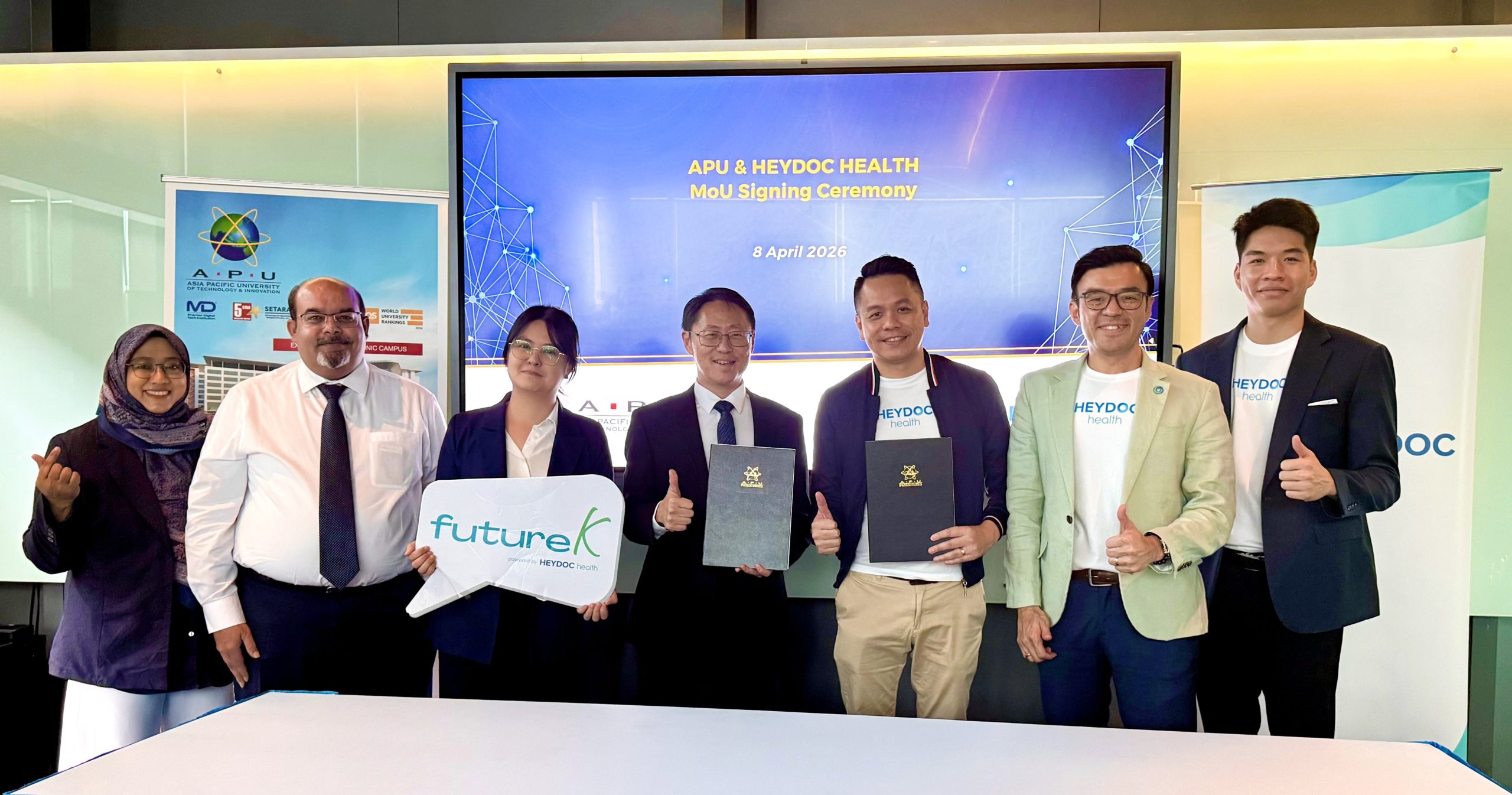
From left to right: Prof. Dr. Hajjah Rohana Sham (Associate Professor, School of Business, APU); Prof. Dr. Kashif Hussain (Senior Head of School, School of Business and School of Global Hospitality and Tourism., APU); Dr. Ye Shing Lourdes Loh (Lecturer, APU); Prof. Dr. Ho Chin Kuan (Vice Chancellor, APU); Dr. Raymond Choy (Co-Founder & CEO, Heydoc Health); Dr. Fabian Lim (COO, Heydoc Health); and Dr. Daniel Seen (Head of Strategy & Growth, Heydoc Health) at the APU & Heydoc Health MoU Signing Ceremony on 8 April 2026.
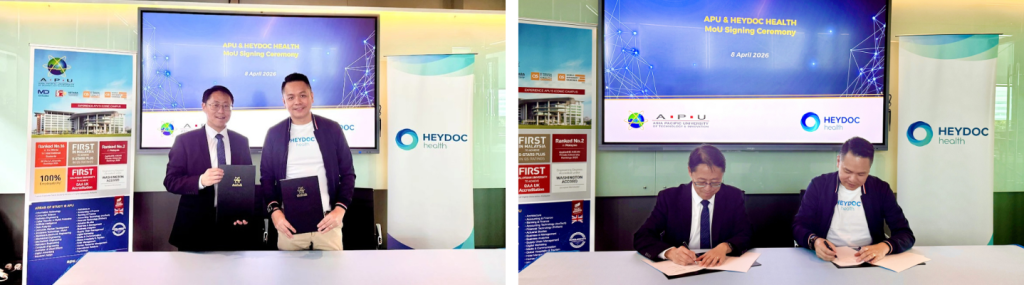
Kuala Lumpur, Malaysia — 8 April 2026 — Heydoc Health Sdn Bhd and Asia Pacific University of Technology and Innovation (APU) have entered into a strategic collaboration to jointly explore the future of AI-enabled digital healthcare through a research initiative focused on improving healthcare supply chain accessibility and affordability for rural and underserved communities in Malaysia.
The collaboration, formalised through a Memorandum of Understanding (MOU) and a research Memorandum of Agreement (MOA), establishes a framework for academic-industry partnership aimed at advancing research, innovation, and practical deployment of digital health technologies. The partnership will combine APU’s academic and research expertise with Heydoc Health’s real-world telemedicine platform capabilities to evaluate how digital healthcare solutions can bridge gaps in healthcare delivery.
What sets this collaboration apart is its deeply integrated, hand-to-hand model where academic researchers and industry practitioners work shoulder to shoulder from research design through to field deployment and policy advocacy. Rather than a conventional consultancy or licensing arrangement, this partnership embeds APU faculty expert from Supply Chain and Health Economics from School of Business directly within Heydoc Health’s operational environment, and conversely, brings industry practitioners into APU’s research and teaching activities.
“At APU, we believe meaningful innovation happens when academic research meets real-world challenges. This partnership with Heydoc Health enables our researchers and students to work hand-in-hand with industry to develop digital healthcare solutions that can improve accessibility, equity, and efficiency in healthcare delivery — particularly for underserved communities. It is this kind of collaborative model that truly accelerates impact.”
— Professor Dr. Ho Chin Kuan, Vice Chancellor, Asia Pacific University of Technology and Innovation
The research initiative will focus on the real-world implementation of Heydoc Health’s digital health platform, which integrates AI-powered triage, teleconsultation with licensed medical practitioners, electronic prescriptions, and pharmacy fulfilment through a nationwide network. Through field deployment in selected rural areas, the programme will generate evidence on how technology-driven healthcare delivery can enhance consultation efficiency, reduce healthcare access barriers, and provide a more sustainable model for outpatient care in underserved regions.
Complementing the supply chain perspective, the research programme will also benefit from the insights of APU’s Health Economics Expert from the School of Business, Dr Lourdes who will lead the economic viability and cost-efficiency strand of the study. This component will examine the cost-effectiveness of AI-integrated telemedicine compared to conventional outpatient care, assess affordability benchmarks for rural populations, and model the long-term economic impact of digital health adoption on Malaysia’s healthcare system.
Assoc Prof Dr Hajjah Rohana Sham, a leading supply chain expert at APU’s School of Business, will co-lead the supply chain stream of the research programme. Her expertise in supply chain resilience, logistics optimisation, and healthcare procurement systems will be central to evaluating how digital health platforms can drive smarter, more responsive supply networks particularly for last-mile delivery of medicines and health products in rural Malaysia.
By evaluating user acceptance, clinical workflow integration, supply chain responsiveness, and economic viability of digital health platforms in rural settings, the research team comprising interdisciplinary academics, clinicians, supply chain specialists, health economists, and public health experts will generate findings with direct relevance for Malaysia’s broader digital health transformation agenda – Prof Kashif Hussain, Head of Business School, Asia Pacific University.
Dr. Raymond Choy, Founder and CEO of Heydoc Health, said the collaboration reflects the growing need to align healthcare innovation with real societal needs.
“Digital health has the potential to transform how care is delivered, but meaningful innovation must be grounded in real-world impact. Through this partnership with APU, we hope to generate strong academic and operational evidence on how AI-enabled telemedicine can improve healthcare accessibility, especially for communities that traditionally face challenges in reaching care.”
The project will involve interdisciplinary researchers, clinicians, and public health experts, with the goal of producing peer-reviewed academic publications, practical policy insights, and technological innovations that could support Malaysia’s broader digital health transformation agenda. The collaboration also opens opportunities for student research, academic exchange, and joint innovation initiatives between industry and academia.
Over the course of the programme, the research team aims to evaluate user acceptance, clinical workflow integration, and economic viability of digital health platforms in rural settings. Findings from the study are expected to contribute to national discussions on healthcare access, digital transformation, and sustainable healthcare models for emerging economies.
The partnership between Heydoc Health and APU represents a replicable model for academic-industry collaboration in the health sector where supply chain efficiency, health economics rigour, and technological innovation are treated not as separate domains but as deeply interconnected pillars of a people-centred healthcare delivery system.